
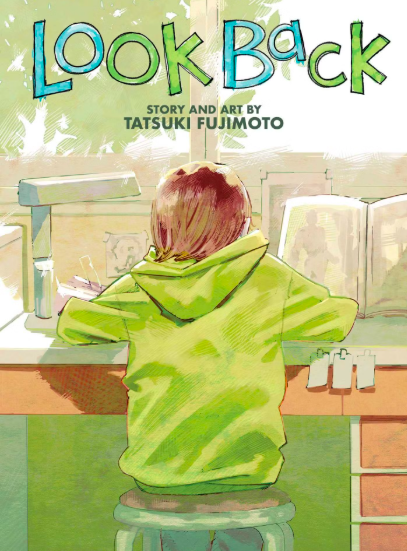
Story by Tatsuki Fujimoto
Art by Tatsuki Fujimoto
Published by Shueisha / Viz Media
Look Back is a one-shot manga about two teenage girls who—through their shared interest in drawing—form a bond that inevitably deepens into friendship, create mangas together, and experience the growing pains of life. Fujino, the main character, is an overly confident comic artist who runs the manga section of her middle school’s weekly newspaper. At first, being the only artist whose four-panel manga, also known as yonkoma, is published in the school newspaper, her peers give her high praise (which she readily eats up). However, at the request of a teacher, a fellow student who stays at home due to her anxiety, Kyomoto, is given a manga slot in the school newspaper to publish her art. It is then, seeing the beautifully detailed scenery of Kyomoto’s work that Fujino first experiences the slightest bit of doubt. To add to that, her peers, given the chance to see another artist’s work, make the common (and careless) mistake of comparing Fujino’s art to Kyomoto.
Initially, Fujino is motivated to improve as an artist. Where she was once complacent, dismissive even, in her efforts to create comics, she now committed to learning the fundamentals. Anatomy, figure and form, values, colour, perspective—she was diligently studying to match what she couldn’t help but feel was her rival’s work, only to be bested once more by Kyomoto’s seemingly effortless artwork depicting various environments. Following this, Fujino, disappointed, decides that maybe drawing wasn’t worth the effort and she should focus on other things. So it goes, until graduation day—the last day of middle school. Fujino is given the task by the same teacher, as the only other manga artist alongside Kyomoto for their school newspaper, of delivering Kyomoto’s diploma to her home. Reluctant at first, Fujino concedes, visiting Kyomoto’s residence, where she learns that Kyomoto has actually been a fan of her manga. What follows is the unfolding of a beautiful friendship and the rekindling of Fujino’s passion for drawing, for creating manga and telling stories.

When I first picked up Look Back, it was still 2025. I was at a standstill in my life, unsure of whether it made sense for me to even consider making art or if I should just go back into working as a corporate researcher. There were many things that I wanted to do (that I felt like I should be doing) and yet, the economy was tough (it still is, frankly), I ended up with a mild case of cubital tunnel syndrome, and dealt with a series of family emergencies that were quite costly.
I was tired and disillusioned.
Admittedly, it took me a few tries to get into this story. I had to borrow and renew a copy from my local library a couple of times before finally taking the time to settle down and really read the story. Nonetheless, I quite enjoyed Look Back. The themes of the story were profound and relevant (especially for me who had been struggling with my love for art); the characters were easy to empathize with; the pace and delivery of the story felt reasonable; and the artwork, although simple, is charming and not at all lacking personality.
While there were moments that I found cringey (who wouldn’t cringe at even the behaviour and tendencies of their adolescent selves) and even moments where I found myself frustrated by Fujino’s ego and manner of speech, especially towards Kyomoto, still this simple story of two girls who just wanted to draw warmed my art.
Interspersed with several “silent panels,” which were rich in imagery and details but contained no dialogue or words, Look Back reminded me a bit of my love for those silent cartoons that I used to look forward to as a child. Each wordless panel was proof of Fujino and Kyomoto’s friendship, it held the youth and joy of every memory they shared; a depiction of their devotion to creating manga; a testament to the countless hours, days, spent with one’s head bent over a sketchbook or a drawing pad, a feeling that many artists know too well.
Fujino, the overconfident artist who became Kyomoto’s strength to step outside of her room (and maybe even dare to dream of going to art school), and Kyomoto, the truant who was Fujino’s motivation to draw again after prematurely throwing in the towel. Both characters, each with their distinctly different personalities, find that who they are inevitably becomes a part of their art, and by extension of their friendship, their creative endeavours.
It was bitter—the rift that befell Fujino and Kyomoto’s friendship. Yet, they remain a constant, quiet presence in one another’s lives as they continue to draw, to create.
Interestingly, there were many references to Kyomoto being Fujino’s “back” or having her back throughout the story. Instances of Fujino telling Kyomoto to “keep your eyes on my back and you’ll grow too”; Kyomoto literally supporting Fujino’s ideas as a background artist for their mangas; Fujino receiving silent support from Kyomoto when her manga got serialized even after their falling out.
More than just a memory, or a person from her past, Kyomoto was the person who supported Fujino’s success and love for drawing—she was Fujino’s spine, her “back,” and continues to be a big part of why Fujino draws.
In the end, when we see Fujino lament her friendship with Kyomoto and her feelings for drawing manga—confessing that it was not fun and that it was even tiresome—an echo of Kyomoto’s presence confronts Fujino with the one question that every artist must come to understand for themselves at one point in their journey: “why do you draw?”

And there, in this moment, the heart of an artist is called to lay itself bare.
We draw not because it is easy or fast. We draw because there is something in our hearts that longs to express itself, to reach out to someone—anyone—and connect. We do it out of love—for others, for the life we once had or still dream of, for the craft itself. We draw because it is how we love.
Fujino drew at first because of the flattery she received from her peers. Then she drew because seeing Kyomoto’s technically refined artwork pushed her to improve, before burning herself out and giving up on the idea of creating manga. But she drew once more when Kyomoto became her friend, and they shared countless moments creating manga together. Now, she continues to draw because she recalls the joy it brought to someone she cares deeply about.
Look Back isn’t just a story about moving forward and growing up, it is about understanding why you felt compelled to walk down a certain road. It is a love letter to the artists who are tired—to the creatives who feel emptied out and swallowed by a world that tries, at every turn, to take their spark.
It is a reminder of what made you draw in the first place. A reminder of how your heart can love.
Although I borrowed a copy to read from the library (something I encourage everyone to do), I see myself investing in a personal copy to reread over the years. It is a simple story. But it is a charming story with much depth, and how much you get out of it depends entirely on how much you are willing to give. Now more than ever, with the age of automation and generative AI, it can be easy for artists to forget why they create. In which case, Look Back is a timely read—a story I would recommend to any artist in need of reminding: why do you draw?
Overall, I give Look Back a 3.75 out of 5 cups of coffee (dark roast).
(I was a bit delayed in posting this review because I had some work projects to wrap up. I also ended up getting sick, so I did nothing for a few days because I was upset about not being able to breathe through my nose properly :(( )
Thanks for reading my review! 🙂 ☕️
Leave a Reply